
| P.V.Tsybin |
|

S-30 (RSS)
cruise missile
The design bureau ordered to create the «RS» intercontinental
supersonic bomber was established at plant №256 under
leadership of P.V.Tsybin on 23 May 1955. The bureau invested
in a project which had many innovations, but insufficient
experience resulted in the overestimation of the designers
capabilities. Therefore claimed performance appeared not to be
realized. The project began a long period of metamorphosis and
was divided into two parts, which were controlled by a piloted
RSR reconnaissance aircraft and RSS (S-30) strategic missile,
owing to the similarity in airframe and launch by carrier-aircraft
method. The missile imaging programme was started on 31 July
1958. To add to the RSS study, Tupolev OKB-156 became the
head enterprise to build the Tu-95S carrier. Initially Tupolev had
harshly objected to Tsibin's idea and he didn't change his
opinion later.
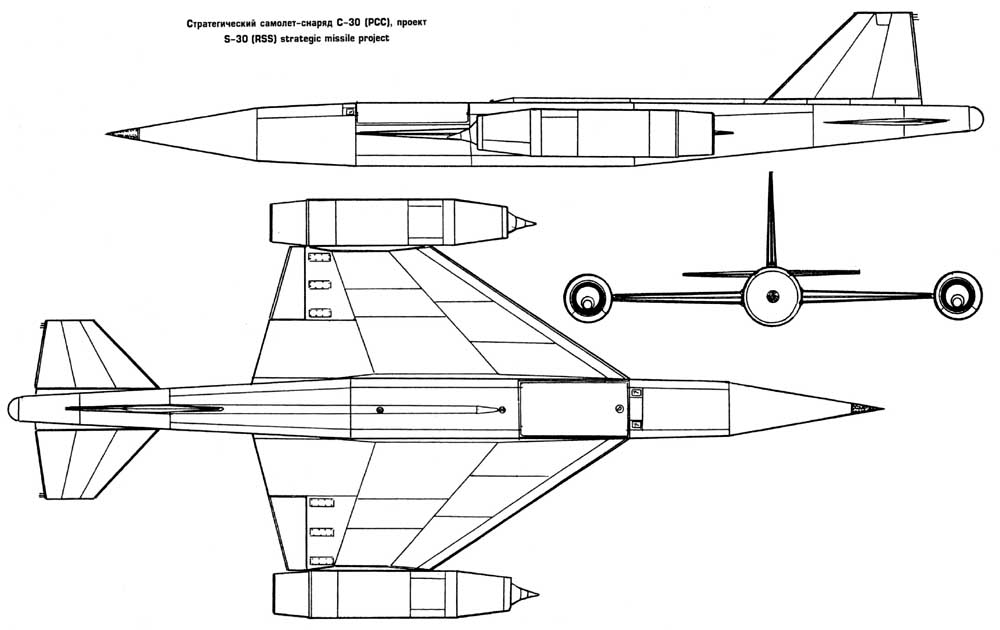
The S-30 missile layout was based on the 2RS project,
retaining its wing, tail unit and power plant comprising a pair
of Bondaryuk OKB-670 RD-013 ramjets. The fuselage was
redesigned and shortened by cockpit area and the special
equipment tail fairing was removed, but nevertheless it was still
longer than 20 m.
The experimental «product 6» (RDS-6s) was supposed to be
the warhead, but allegedly prod. 37d , the single realistic
contemporary serial thermonuclear charge, could be employed.
This had weight and dimensions similar to the RDS-6s. The
missile was supposed to feature astro-inertial flight management
system. It was planned that controlled by a pilot analogue-
aircraft would be built for the systems development and
preliminary evaluations.
The RSS missile had a number of design and technology
drawbacks. First of all the wing main panels weren't divided on
subassemblies and it took three teams operating schedule up to
4 months to build these in pilot-scale production conditions.
The main panel-to-fuselage fit wasn't thought out well. Very hard
mass limits set by the designers for themselves forced the
employment of untested materials to provide weight reductions.
One of them was the AB aluminium-beryllium alloy which
appeared to be very toxic.
The missile's design and construction was significantly
behind schedule. The carrier production showed the same delays
and Tupolev claimed this was due to the size of the platform.
Nevertheless, the RSR carrier was built and 0KB-156 studied the
Tu-95 versions to convey «100» cruise missiles and «113» drone
reconnaissance aircraft. The latter's weight and dimensions were
superior to Tsibin's projects even.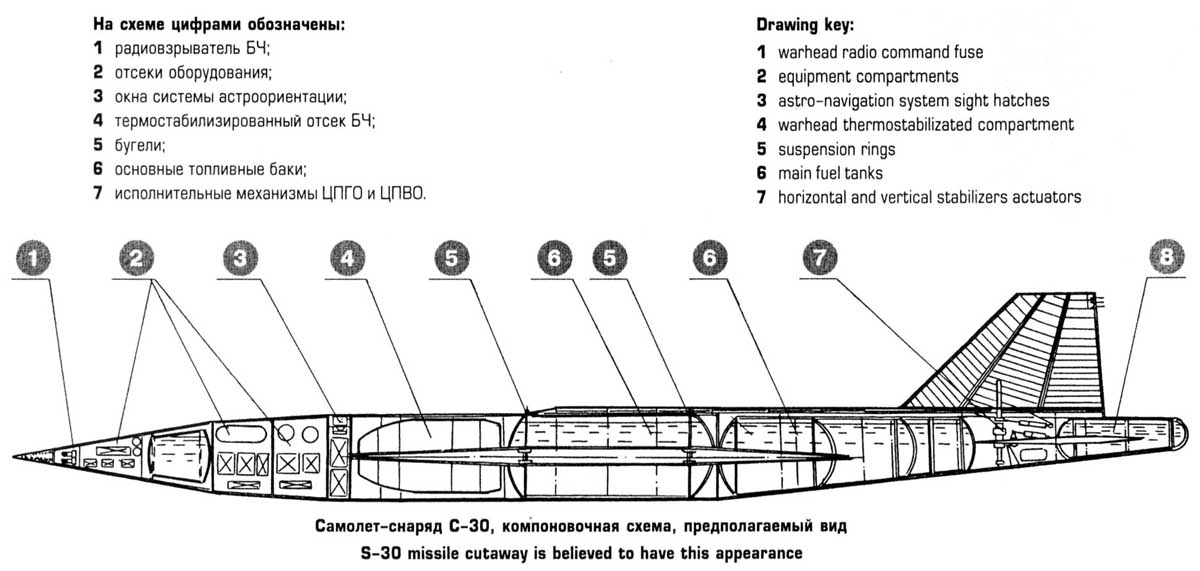
OKB-256 staff was allocated to plant # 23 in 1959 to work
on missile themes under V.M.Myasishchev's general leadership.
The RSS missile, being in final stages of projection, had no 3M
and M-50 suspension capability because of their low height,
Furthermore, the OKB-23 was disbanded soon after. The special
designers team which had been established with V.M.Myasishchev remained temporarily at the plant. This included
V.B. Shavrov and P.L.Bartini to add to P.V.Tsibin. Among other
things they tried to adopt the RSS to the huge
A-57 seaplane
bomber. But the aircraft failed to be built for different reasons.
The S-30 and R-020 (the last RSR project conversion) studies
were halted in 1960.
| Description | |
|---|---|
| Design | OKB-256 P.V.Tsybin |
| Type | RSS (S-30) |
| Function | cruise missile |
| Project | 1958-60 |
| Guidance system | Astro-inertial, preprogrammed autopilot |
| Dimensions & Weight | |
| Length, m | about 22,5 |
| Body diameter, m | 1,5 |
| Wing span, m | 9 |
| Wing area, m2 | 64 |
| Takeoff weight, kg | about 22000 |
| Power-plant | |
| Engine | 2 ramjet RD-013 |
| Trust, kgf (kN) | 5600 (43,2...44,1) |
| Performance (project) | |
| Cruise speed, M= (m/s) | 2,5-2,7 (777) |
| Permitted speed of launch, km/h | 800...850 |
| Launch range, km | up to 5000 (2000) |
| Cruise flight altitude, m | 20000 (18000-24000) |
| Armament | |
| Warhead type | RDS-6S (product 205K) |
| Warhead action principle | Thermonuclear |
| Warhead weight, kg | 1800 |
| TNT equivalent, kt | 400 |
References and Credits:
- Soviet long range and naval aviation missiles / S.Moroz, S.Popsuevich, «Major», «Pilot», 2001 /
- «To it to be a rocket» / I.Afanasiev, V.Bobkov, «Ace» 1/1993 /
- «Outstripped time» / V.Maksimovsky. «Air Fleet Herald». 6/96 /
- «PVRD - the task for tomorrow» / E. Erohin, «Engine» #1'2001 /